Showing posts with label China. Show all posts

Saturday, 9 July 2016

A Mathematician's Holiday - Problem 7: Fix the Hotel Rooms.


Requirements:
Pen and paper is all that is required. We also use blow up rubber ring to demonstrate the solution.
Description:
Having got to our hotel rooms Dan, Will and I found that our water, electricity and gas supplies had all been damaged in the fire. Being the helpful souls that we are can we connect each of the utility supplies to each room without crossing the utilities?
Figure 1. Problem set up.
This is a classic mathematical problem known as "The Three Utilities Problem". Critically, it is known to be unsolvable on the flat sheet of the paper. However, the hotel we would be staying in would be three-dimensional and, thus, we are asking the audience to extend their ideas beyond the flat surface.

Note that we really do not go into why the solution is impossible on the flat paper. The reason is because the proof of impossibility depends on some deep ideas from topology. However, the interested reader can find the proof here.

Extension
If we add in another utility, can we still solve the problem on a torus, or doughnut?

Saturday, 25 June 2016

A Mathematician's Holiday - Problem 6: The Tiny Lift.

Requirements:
We use two beards to go along with the story that we have concocted. However, you can use two hats, two name badges, etc. Anything that will denote two objects as being similar.
Description:
Once we got into the hotel we found that the lift to our floor was very small. This meant that only  one of us could go up to the first floor at once. This leads to a problem: you see Will and I have bonded over our beards, whilst Dan does not have any facial hair! Thus, neither Will nor I want to be left alone with Dan because we would have nothing to discuss. How do you get us all from the ground floor to the first floor, without ever leaving an hirsute person with a beardless person?

Figure 1. Problem set up.
This problem is simply the fox, chicken, grain problem, a classic brain teaser that has been around for centuries. The audience should have no problem producing an adhoc solution in no time. However, there are two key factors that should be extracted. Firstly, having them demonstrate the problem is a very fun, visual and hilarious thing to do, if you are using beards and, so, it rejuvenates a flagging audience. The second (mathematical) point of the solution to extract is that the audience probably solved the problem by trial and error, however, the solution can be solved neatly by using a graph, just like the "airport security" problem.

Extension 1
Can you solve these two related, but different transport problems:
Vampires and maidens
Three maidens and three vampires must cross a river using a boat which can carry at most two people, under the constraint that, for both banks, if there are maidens present on the bank, they cannot be outnumbered by vampires (otherwise the vampires would bite the maiden).
Jealous husbands
Three married couples want to cross the river in a boat that can only hold two people. Unfortunately, no woman can be in the presence of another man unless her husband is also present.

Extension 2
How is the vampire and maidens puzzle related to the Jealous husbands puzzle?

Saturday, 11 June 2016

A Mathematician's Holiday - Problem 5: Hotel Fire!

Requirements:
Some pieces of string, or rope, depending on the size of your demonstration and a play to draw the diagram below in Figure 1. Note that it does not have to be too accurate.
Description:
Having got to the hotel we unfortunately find that it is on fire. Thankfully, there is a river very close to our location, where we can load up buckets with water and, thus, help put the fire out. What is the quickest route from our location, to the river and to the hotel?
Figure 1. Problem set up.

This problem is very similar to "Late for the Plane" and works well if they are done in combination with one another. Again, the question relies on using the ropes to measure distance, in order to measure time.

A critical point for the audience to understand is that the helpers all run at the same speed, even when they are carrying water.

Extension:
Suppose we run slower once we are carrying water. How does this extra facet influence the solution?  Note that you can solve this problem as well, however, but it is far more involved and involves calculus.


Saturday, 28 May 2016

A Mathematician's Holiday - Problem 4: Bags Mix-up.

Requirements:
Three bags with different named labels. A t-shirt or jumper. Of course, you can dress this problem up in many different ways so if you have got a t-shirt or jumper to hand you could have three pencil cases with blue and yellow pencils, for example.

Description:
En route to China our luggage got mixed up. Each of our bags look the same, but the name tags have all been mixed up such that we know that no bag has the correct label (a key point to reiterate). We are allowed to put our hand in a bag of our choice and pull out an object at random (we can look in the bag). Can we identify which bag belongs to each person, from this single piece of information?

You should ensure that the audience understands that we are looking for a definite strategy. We do not need to consider probabilities at all.

Extension:
To be honest, I cannot think of one. This question is pretty much self contained. However, the idea behind this question, i.e. logical deduction, is one of the crucial weapons in the mathematical arsenal. If you have any suggestions for extensions please write them in the comments below.

Saturday, 14 May 2016

A Mathematician's Holiday - Problem 3: Late for the Plane.

Requirements:
Some pieces of string, or rope, depending on the size of your demonstration and a play to draw the diagram below in Figure 1. Note that it does not have to be too accurate.

Description:
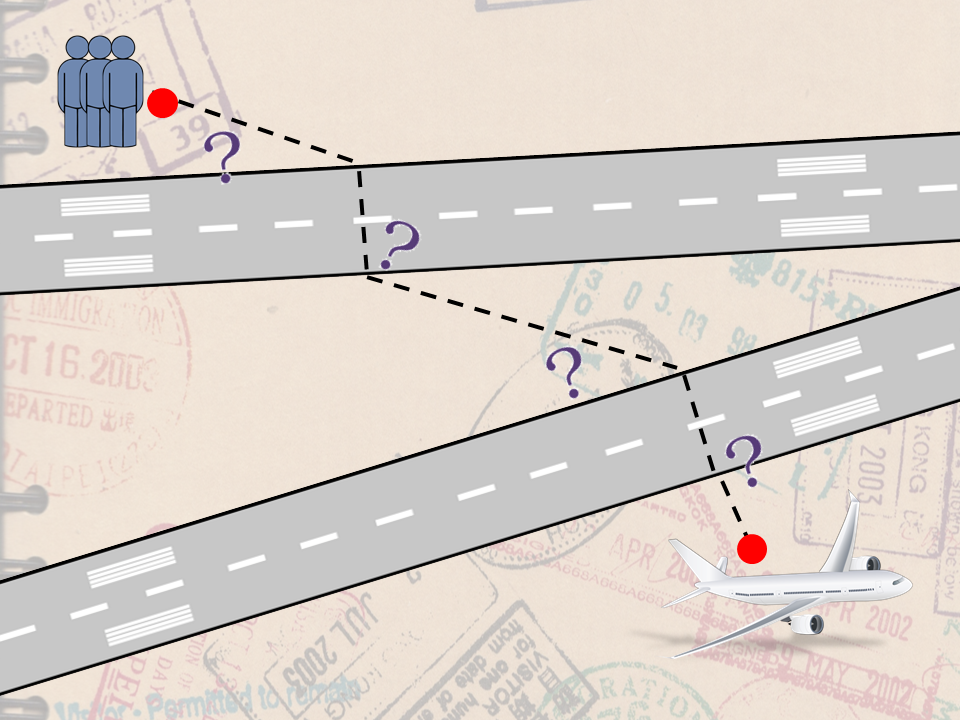
The critical point to ensure for this question is that you're audience is comfortable with the idea of a straight line between two points being the shortest distance between those two points and, thus, the route of shortest distance.

We are late for our plane and so we want to take the quickest route from the terminal our aeroplane. However, there are two active runways between us and our destination. Since these are dangerous places to be we want to ensure that we minimise our time over the runways and, so, we always run directly across, at right angles to the runway direction. What path minimises our total distance?
Figure 1. The problem set up.

Unless they've seen the problem before it is highly unlikely that your audience will generate the solution shown in the video. However, that does not matter. The fundamental concept we are trying to introduce here is that we are looking for a method, rather than an exact solution. Thus, it should be made clear to the audience that the problem set up does not need to be exact.

Extension
In what case is the shortest route from the terminal to the plane an actual straight line?

Saturday, 30 April 2016

A Mathematician's Holiday - Problem 2: Airport security.

EASY VERSION
Requirements:
Two containers in the ratio 3:5, for example 75ml and 125ml. We used the bottom of drinks bottles and scaled up the quantities in order to make them more visible for a large audience.

Description:
Airports only allow 100ml of fluid through onto a plane. Can we measure out exactly 100ml of fluid using containers that are of the sizes given above and none of the containers have graduation marks? Beyond the trial and error that the audience may try you can actual solve this problem very easily using a graph.

Figure 1 shows a graph illustrating the volume on liquid contained in each. Filling and emptying each container corresponds to horizontal movements, all the way to the left and all the way to the right. Transferring the liquid from one container to the other corresponds with travelling diagonally as far as you can go. By using these two rules you can easily bounce around the graph and successfully reach 100ml.
Figure 1. Solving the fluid problem graphically. The volume of water in the 75ml bottle in along the vertical axis and the volume of water in the 125ml bottle in along the horizontal axis.
Extensions:
In Figure 1 we filled the 125ml bottle first. Can you solve the problem by filling the 75ml bottle first?
What values of fluid can you not possibly make using this method of pouring between the containers?

HARD VERSION
Requirements:
Three containers in the ratio 3:5:8, for example 75ml, 125ml and 200ml.

Description:
The task is the same as above. However, this time we do not have a reservoir of water to fill from, and empty to. We only have a container of 200ml of water, which can be transferred amongst the different sized bottles.

Critically, the solution to this problem depends on ternary coordinates, which are plotted in a triangle form, as seen in Figure 2, see the video for more details. Once the students have seen this form of graph they are able to solve the problem in exactly the same way as the previous question.
Figure 2. Ternary coordinate plot. Each side of the equilateral triangle represents the volume in one of the bottles. Each of the stars represents one of the points on the left. See the video for more details.
Extensions:
Again, what values of fluid can you not possibly make using this method of pouring between the containers?
Instead of starting with 200ml, suppose we started with 125ml only. What fluid volumes can now be made by transferring the fluid between the bottles?

Saturday, 16 April 2016

A Mathematician's Holiday - Problem 1: Planning the tour.

Requirements:
Each participant should have a pencil, paper and rubber to draw and modify the diagram shown in Figure 2.

Description: 
In this activity we set the scene of the whole presentation. In particular, we talk about how all the activities were motivated by problems that we faced on our tour. The first problem is then, of course, organising the tour.

As mentioned previously we visited a number of locations around China and South Korea. These locations are shown in Figure 1.
Figure 1. All of the locations we visited on our tour.
Being huge tourists, we didn't want to have to travel between these locations in the same way twice, because each transportation route would allow us to see something different. In Figure 2 we represent each method of transportation by a black line between each of the cities. For example, the O and L mean Oxford and London and the two black lines represent the two different transportations of train and bus.
Figure 2. Representing the city connections.
The challenge is then to find a way around all the cities using all possible forms of transport. We found that we were not able to solve this problem. Can you? Of course the answer is contained in the video at the top.

Extension
From watching the video you should be able to see that identifying whether a set of paths are completely traversable with no repeating is pretty easy. However, suppose we specified the time each path took, how difficult would it be to find the quickest path around all cities?

Saturday, 2 April 2016

A Mathematician's Holiday - Prologue.

One of the first activities that got me into outreach was joining Marcus' Marvellous Mathemagicians (M3), which was started in 2008 by Marcus du Sautoy. The idea was that hundreds of schools contact Marcus every year to give presentations to their kids, but unfortunately he simply doesn't have the time to answer all the requests. Thus, myself and a number of other undergraduates and graduates go out to schools and take a number of fun mathematical workshops
Multiple Oxford scientists coming out in force at the Newbury Science Festival
As part of M3, I've been up and down the country giving maths workshops, over to Ireland and Wales, and presented at numerous science festivals across the country.

However, perhaps the best experience I've ever had was when myself, Will Binzi and Dan Martin were invited to tour around the Dulwich Colleges of China and South Korea and demonstrate mathematics to all the kids out there.
From left to right: Dan, Will and myself enjoying the view from the Great Wall.
During our two weeks out there we travelled to Beijing, Suzhou, Shanghai, Zhuhai and Seoul. By the end of the two weeks we were of course exhausted but extremely happy because our workshops had gone down so well.
We presented in classrooms and theatres. The Dulwich college kids were great audiences.
Specifically, because this was a very special tour we decided to write a brand new presentation for the Dulwich students. The presentation was called A Mathematician's Holiday and collected eight different problems that you might come across whilst planning and presenting on such an international tour.
When we came back we decided to film the presentation so it can be used by anybody. The videos can either be found on YouTube, iTunes U or through the University of Oxford's Podcasts page. Over the next 8 weeks I will be presenting each video and discussing any particular techniques that we found aided us in our presenting the workshop.

Crucially, because we were taking this tour on the road, we had to make sure all the props were light, transportable, easily fixable, reproducible, or cheap to buy. In the end we simply used:
  • rope;
  • plastic bottles;
  • bears;
  • a t-shirt;
  • a jumper;
  • three hold alls; and
  • a blow up ring.
As a final note on the videos, they're pretty low energy. Normally we would have been giving this presentation in front of 30-50 excitable kids. Here we had 6 sixth-form students and a doctoral researcher, not exactly our prime demographic, but it had to do!

We begin next time by organising the tour!